
How AI Is Changing the Way People Find and Use Websites
Part 1 of 4 — Iceberg’s “Websites in the AI Era” Series
You’ve probably noticed that your relationship with the internet is changing. You ask ChatGPT a question and get an answer without clicking anywhere. A colleague found a vendor through an AI recommendation. Your website traffic looks a little different than it did two years ago. These things are connected, and they add up to something real: the web is changing, and websites need to change with it.
This is the first post in a four-part series from the Iceberg Web Design team. Each person has a different perspective, all answering same question: how is AI changing the world of websites, and what do business owners need to know right now?
Here’s what the full series covers:
- Part 1 (this post): How AI is changing the way people find and use websites: search, discovery, and on-site experience.
- Part 2: Why authenticity, personality, and human connection matter more than ever as AI saturates the internet.
- Part 3: How AI is reshaping WordPress development, including a security threat every site owner needs to hear about.
- Part 4: The new rules of website security in an AI-powered world.
Each post features predictions from our team members in their own words, followed by an explanation of what it means for your business.
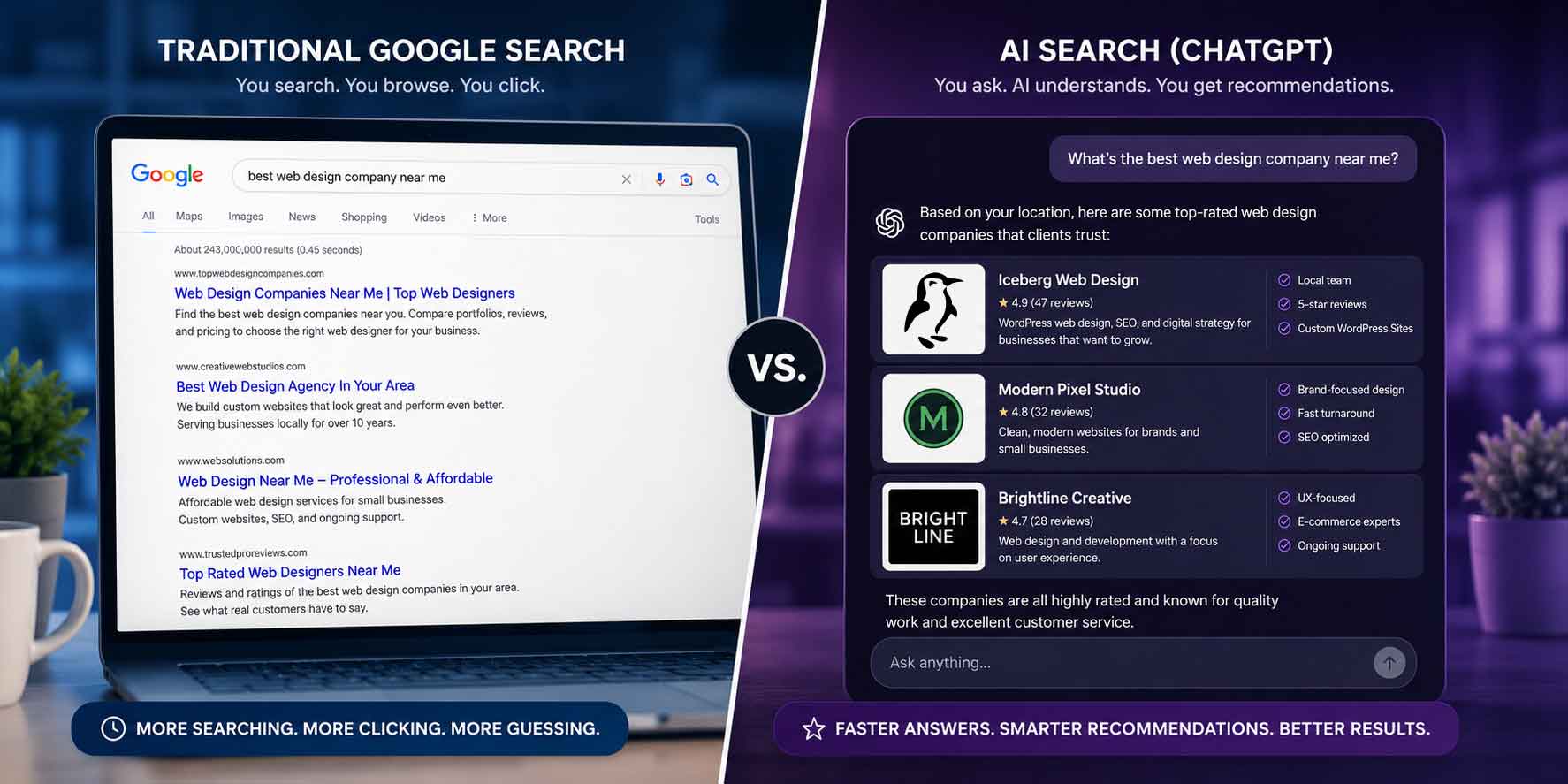
This week, we start with five predictions about how AI search tools are fundamentally changing how people find businesses online, and what you need to do about it.
Jessie: Websites That Talk Back
My prediction (or guess) is talking websites where the user asks questions and AI will either answer the question and bring them to the content to show the user the answer to the questions. Our new slogan – We build smart websites, not just pretty ones. Just ask us!
I mean Siri has been around for a while already.
Jessie’s prediction gets at something that’s already beginning to happen: websites that don’t just display information, but respond to it. Instead of a visitor clicking through menus to find what they need, they ask a question, and the site answers it and navigates them directly to the right page. Think of it like having a knowledgeable staff member on your website 24/7, ready to help any visitor instantly. It’s the natural next step from voice search and chatbots, and it changes the whole purpose of a website. A digital brochure sits there. A smart website has a conversation.
The technology isn’t science fiction. Siri launched in 2011. What’s new is that this kind of experience is now practical and affordable for small and mid-sized businesses, not just big brands with massive budgets.
What this means for your business: If your website can’t explain what you do clearly enough for an AI to surface the right page, it probably can’t explain it clearly enough for a human visitor either. That’s the place to start.

Mariann: Websites as Second-Step Destinations
With the continued growth of AI tools, more users will get answers without ever clicking through to a website. In 2026, we’ll see a noticeable shift where websites receive less top-of-funnel traffic from traditional search. Instead, sites will need to focus on being strong second-step destinations, where users go to validate, compare, and take action. Businesses that rely heavily on organic traffic will need to adapt quickly to stay visible.
Mariann is pointing to a real shift in where websites sit in the buyer journey. When she mentions “top-of-funnel traffic,” she means the visitors who are just beginning their research — people typing broad questions into Google to learn the basics before they know what they want to buy. AI tools are increasingly handling that early research stage directly in search results, which means fewer of those early-stage visitors make it to your website.
The visitors who do arrive are further along in their decision; they already know what they want and are now comparing options. That changes what your website needs to do. It needs to be built to convert, not just to inform. Service pages, testimonials, and clear calls to action matter more than ever.
What this means for your business: Look at your contact page, your pricing page, and your reviews. These are becoming more important than blog traffic as AI handles the early research stage and sends more intentional visitors directly to your site.
Shane: Your Website Needs to Become the Source of Truth
One of the biggest website trends in 2026 will be building websites that are optimized for both people and AI platforms. A strong website will need to do more than look professional. It should clearly explain who you are, what you do, where you serve customers, and why people should trust you. With tools like ChatGPT, Gemini, Perplexity, and Google AI Overviews influencing how people find businesses, your website needs to become the source of truth that search engines and AI tools can confidently understand, reference, and recommend.
Shane’s prediction goes deeper than traditional SEO. For an AI tool to confidently recommend your business, it needs to understand your website clearly, without any guesswork. That means writing your web pages the way a knowledgeable friend would explain your business: plainly, specifically, and with all the details that help someone decide to trust you. Vague headlines and thin About Us pages are invisible to AI recommendation tools.
This is why we’ve built AI Optimization (AIO) and Generative Engine Optimization (GEO) into our services — making sure your website is structured in a way that both search engines and AI tools can read, understand, and confidently recommend. If you haven’t heard of AIO and GEO yet, they’re the newer discipline that sits alongside search engine optimization — optimizing your content specifically to be found and cited by AI tools like ChatGPT and Perplexity.
What this means for your business: Audit your site for clarity, not aesthetics. Can a first-time visitor — or an AI tool — read your homepage and immediately know who you serve, where you’re located, and what makes you different from the next option? If the answer is no, that’s your first fix.
Tabby: Reviews Are Becoming a Discovery Signal
I do think there will definitely be an uptick in AI usage with websites for companies. I think that AI will help people searching on platforms looking for specific goods or services and provide the searcher with the website with the most reviews and information related to their search.
Tabby’s prediction has real practical weight. AI recommendation tools don’t just pull from your website; they pull from the broader web, including Google reviews, industry directories, and mentions across the internet. A business with a strong review presence is giving AI tools more positive signals to work with. Your reviews are effectively part of your discoverability, even when they live off your website entirely.
This is the kind of shift that catches businesses off guard. You didn’t change anything on your site, but your visibility dropped because a competitor has three times as many recent reviews. Building and managing that online reputation proactively (collecting reviews, responding to them, and monitoring your presence) is something we help clients with through our Reputation Management service.
What this means for your business: If collecting Google reviews hasn’t been a consistent habit, now is the time to make it one. Recency and volume both factor into how AI tools weigh your business against competitors.
Nikolay: Search That Understands What You Mean
AI-powered search will replace traditional keyword-based search on most websites. Traditional search systems, like those commonly used in WordPress, rely heavily on exact keyword matching and often fail to understand user intent. In 2026, I believe more websites will adopt AI-driven search that can interpret meaning, handle typos, and understand context rather than just words. This will allow users to search in a more natural way, almost like having a conversation with the website. From a business perspective, this can significantly improve user experience, increase engagement, and lead to higher conversion rates. While basic implementations are already accessible, the real value will come from combining AI with existing search systems and continuously improving results based on user behavior.
Nikolay is describing a shift in how the search box on your own website works. Traditional search only finds what you type, word for word. AI-powered search figures out what you actually mean. A visitor who types “how do I get my site fixed fast” is asking the same thing as someone who types “emergency WordPress support,” but traditional search treats those as completely different queries and may return nothing useful for either. AI-powered search connects the intent to the answer.
For e-commerce sites, membership platforms, and content-heavy websites, this matters directly for conversions. Users who can’t find what they’re looking for simply leave.
What this means for your business: If your site has a search function, test it right now. Type something vague or misspelled and see what comes back. Empty results or wrong answers are a user experience problem with a direct cost in lost business.
The Pattern Across All Five Predictions
The thread connecting these five predictions is the same: AI is moving from the background of the internet into the navigation layer. It’s changing how people find websites, how they search within them, and which businesses get recommended. The sites that perform best right now aren’t necessarily the most beautiful ones. They’re the ones built to be understood, trusted, and recommended by both humans and the AI tools humans increasingly rely on.
Coming Up in Part 2 of the Websites in the AI Era Series
As AI makes it easier to produce content, build sites, and automate communication at scale, something unexpected is happening: people are starting to crave the opposite. In Part 2, the Iceberg team shares their predictions around authenticity, brand personality, and why a real human answering the phone might become one of the most powerful things a business can offer.
Ready to Build a Website Built for the AI Era?
The Iceberg team builds websites with the next few years in mind, not just today’s current trends. If you want a website that performs for both human visitors and AI discovery, let’s talk. Feel free to contact us online or call 763-350-8762, we are Website Developers Who Answer the Phone!®